
Tax Benefits of Owner-User Commercial Property Ownership in 2026
Owner-user commercial real estate ownership delivers four tax advantages that reduce taxable income every year the building is held: mortgage interest deductions, property depreciation, qualified improvement expensing, and capital gains deferral on sale.
The interest on an acquisition loan is deductible as a business expense against taxable income. The building itself depreciates over a 39-year straight-line recovery period under the Modified Accelerated Cost Recovery System. That annual deduction offsets income without touching cash reserves.
Qualified improvements — roofs, HVAC systems, fire protection systems, alarm systems — can be fully expensed under Section 179 rather than spread across decades. The Section 179 deduction limit for tax year 2025 is $1,250,000, with a phase-out threshold beginning at $3,130,000 in total property placed in service. Both figures adjust annually for inflation.
On sale, capital gains taxes on the proceeds can be deferred by rolling into a like-kind replacement property through a Section 1031 exchange. The Tax Cuts and Jobs Act of 2017 limited Section 1031 treatment to real property not held primarily for sale. Owner-occupied commercial buildings qualify fully under that standard.
SBA 504 loan financing requires the business to occupy at least 51 percent of an existing building, or at least 60 percent of a newly constructed one. These loans carry below-market fixed rates and low down payment requirements, making ownership accessible to businesses that cannot fund an all-cash acquisition.
Taken together, these four mechanisms create a compounding tax shield — one that reduces taxable income annually, eliminates exposure to rent escalations, and builds equity in an asset that can be sold or exchanged on a tax-deferred basis. Whether ownership produces superior economics compared to leasing depends on current submarket conditions, local lease escalation structures, and the specific terms available on acquisition financing.
Last Updated: August 24, 2026
- • Why Most Businesses Are Paying a Hidden Tax on Their Own Lease
- • Depreciation and MACRS: The Foundational Tax Shield
- • Cost Segregation: The Tool That Separates Components from Structure
- • Interest Deductions and SBA 504 Financing: Structuring the Purchase to Maximize Write-Offs
- • The 1031 Exchange: Deferring Capital Gains When You Eventually Sell
-
• Frequently Asked Questions
- • What are the primary tax advantages of owning my commercial building instead of leasing in 2026?
- • How does cost segregation actually work, and do I need an engineer to do it?
- • Can I use an SBA 504 loan to buy commercial property, and what are the occupancy requirements?
- • How do mortgage interest deductions reduce my effective borrowing cost as an owner-user?
- • What are the tax implications if I lease out a portion of my owner-occupied commercial property?
- • How does a 1031 exchange work when I sell my owner-user commercial building?
- • Where These Tax Benefits Actually Show Up — and What They Require
Why Most Businesses Are Paying a Hidden Tax on Their Own Lease

Every Southern California commercial lease has a clause that grows. It's built into the document on purpose. The landlord decides the schedule. You don't.
That payment doesn't build equity. It doesn't generate a deduction. It moves in one direction — out of your operating budget and into the landlord's — and nothing comes back.
The buy-vs-lease question in Southern California in 2026 isn't a real estate question. It's a math question. One payment is fixed and deductible. The other only moves up.
How Commercial Lease Escalation Clauses Work Against You
Commercial lease escalation clauses come in different forms. But they share one design principle: your landlord's inflation exposure gets transferred to you.
- Fixed-percentage bumps — 3 percent annually, whether the market moved or not. Your cost goes up. The landlord's doesn't.
- CPI-linked clauses — your rent tracks a government index you didn't negotiate and can't influence.
- Fair market value resets — at renewal, the landlord reprices to whatever comparable space is doing right now. You find out when the offer arrives.
An owner-user who buys their building locks in a fixed mortgage payment on day one. That number doesn't move in year three. It doesn't move in year seven.
What felt like a market-rate lease in year one becomes an expensive commitment by year five — because CPI kept adjusting, and your landlord kept collecting. The owner-user's occupancy cost stays flat. The landlord dynamic doesn't get managed. It disappears entirely.
The Wrong Way Businesses Evaluate This Decision
Most businesses compare the monthly mortgage payment to the monthly rent check. That's the wrong comparison.
The mortgage payment is a starting point. It kicks off a calculation that includes depreciation deductions, interest write-offs, and equity accumulation. The rent payment is an ending point — it delivers occupancy and nothing else.
Those aren't the same instrument. Comparing only the monthly cash outlay is like comparing a stock purchase to a utility bill because both cleared your bank account. When exclusive owner-user representation is structured around current submarket economics, that comparison shifts — what looked like the higher monthly cost becomes the lower long-term one once the tax shield is applied.
The other mistake is evaluating the decision against the rent you're paying right now.
Today's rent isn't the number that matters. The number that matters is what that same lease costs in year seven, after three rounds of CPI adjustments, while your competitor's mortgage payment hasn't moved once. That gap is your landlord's margin. And every year you don't own, you're the one funding it.
| Cost Factor | Commercial Lease (Tenant) | Owner-User Purchase (Occupant) | Who Controls the Number |
|---|---|---|---|
| Monthly occupancy cost | Rent payment — fixed to a schedule the landlord sets | Mortgage payment — fixed at closing, locked for the loan term | Landlord (lease) vs. Business owner (purchase) |
| Annual cost trajectory | Escalates on a pre-defined schedule — percentage, CPI, or fair market value reset | Stays flat — principal and interest do not increase on a fixed-rate loan | Landlord (lease) vs. Business owner (purchase) |
| Equity accumulation | Zero — every payment exits the business and builds the landlord's balance sheet | Every payment reduces loan principal and builds an owned asset | Landlord (lease) vs. Business owner (purchase) |
| Tax deductibility | Rent is a deductible operating expense — nothing more | Mortgage interest and annual depreciation both generate deductions that compound over time | Landlord (lease) vs. Business owner (purchase) |
| Improvement cost recovery | Tenant improvement dollars are negotiated per lease term — and may not be recovered at exit | Qualified improvements can be immediately expensed under Section 179 rather than depreciated over decades | Landlord (lease) vs. Business owner (purchase) |
| Renewal leverage | Landlord reprices at renewal — tenant negotiates from a position of dependency | No renewal event — the business sets occupancy terms indefinitely | Landlord (lease) vs. Business owner (purchase) |
| Exit value | None — vacating the space returns nothing to the business | Property can be sold, leased to a third party, or exchanged on a tax-deferred basis under Section 1031 | Landlord (lease) vs. Business owner (purchase) |
Depreciation and MACRS: The Foundational Tax Shield

Depreciation isn't a purchase benefit. It's an annual one.
The IRS assigns nonresidential commercial property a 39-year straight-line recovery period under the Modified Accelerated Cost Recovery System. Every year you own the building, you deduct a fixed fraction of its depreciable basis from taxable income. That deduction runs whether the property is appreciating, depreciating, or sitting flat.
Here's the part most business owners miss: the depreciation deduction is a non-cash expense. No money leaves your account. You don't write a check to claim it. It reduces the income your business reports to the IRS — and that reduction compounds across every year of ownership.
The 39-Year Recovery Period and What It Means for Your Tax Bill
The 39-year recovery period is set by Section 168 of the Internal Revenue Code. It doesn't fluctuate with interest rates, local submarket cycles, or what comparable buildings are doing. You lock in the deduction schedule on the day you close. The landlord doesn't touch it. The market doesn't touch it. It runs.
A business that owns its building claims a fixed annual depreciation deduction for the entire 39-year recovery period. The tenant in the space next door watches rent climb on a CPI or fixed-percentage escalation schedule — with no deduction growing alongside it. The full picture of how those escalating lease obligations stack against a fixed mortgage and depreciation schedule reshapes the math entirely. One number is locked. The other only moves up.
This is the foundational layer. Everything else — Section 179 expensing, interest deductions, cost segregation — builds on top of it. But straight-line depreciation under MACRS is the one that runs quietly every year. No additional transaction. No qualifying event. No annual decision required.
Why the Depreciation Deduction Matters Even When You're Building Equity
The depreciation deduction doesn't stop when your building appreciates. That's the part that catches most buyers off guard. The IRS doesn't care that your asset is gaining market value — the deduction clock keeps running regardless. You're recording a paper loss on your tax return while holding an asset that may be worth more than the day you bought it. Both things are true at the same time.
For Los Angeles tenant rep advisors working through owner-user acquisitions, this reframes the entire decision. The business owner isn't just buying a building. They're buying a deduction that offsets operating income every single year — independent of what the property does in the market. Equity builds on one track. Tax savings run on a parallel one. Both move in the owner's favor at the same time.
| Property Classification | IRS Recovery Period | Depreciation Method | Typical Components |
|---|---|---|---|
| Nonresidential Commercial Property | 39 years | Straight-line | Office buildings, retail centers, warehouses, medical suites |
| Owner-Occupied Commercial Building | 39 years | Straight-line | Entire structure depreciable basis; excludes land value |
| Inflation-Hedged Owner-User Asset | 39 years | Straight-line | Strategic acquisition shielding companies from rental volatility and capital decay |
Cost Segregation: The Tool That Separates Components from Structure
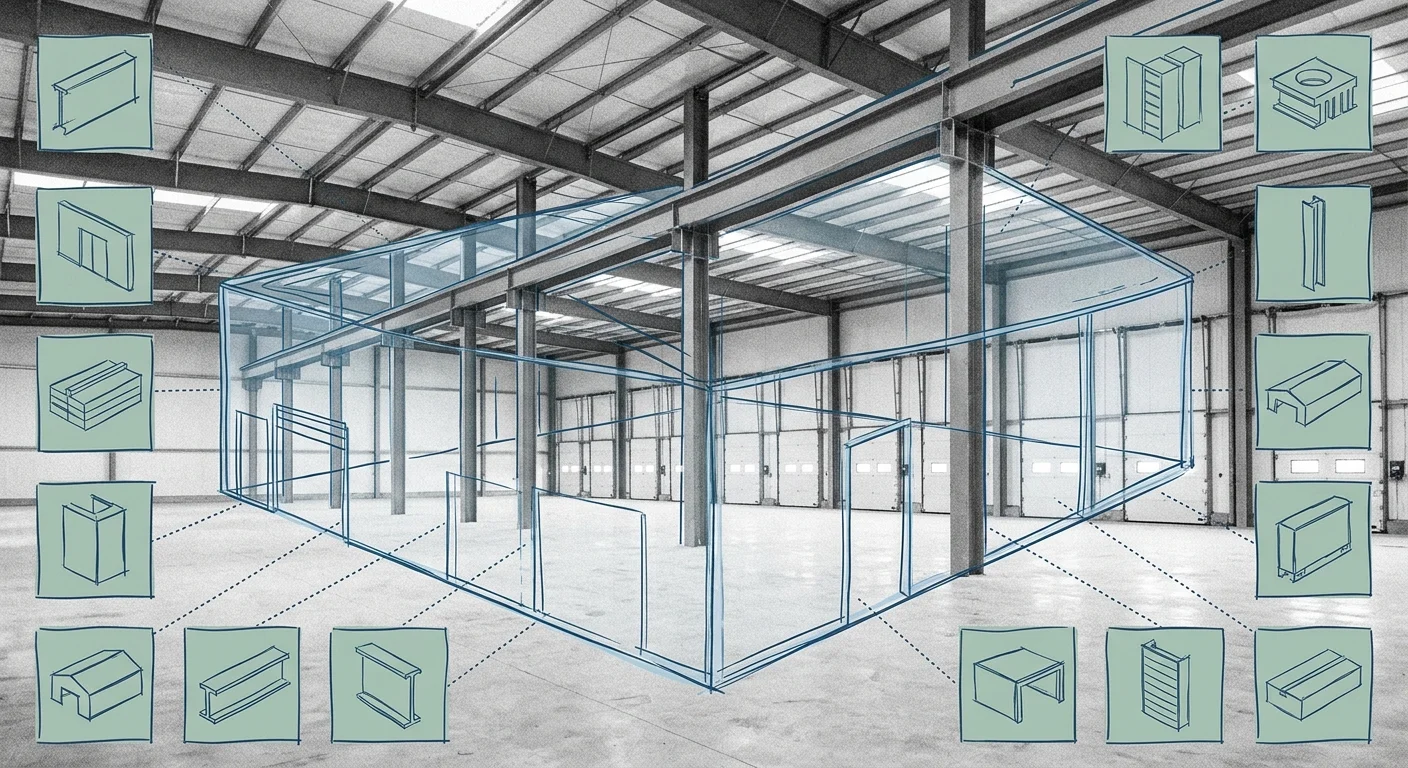
Cost segregation is what turns passive depreciation into active tax strategy. Instead of treating the building as one 39-year asset, a cost segregation study breaks it apart — identifying which components depreciate faster, on shorter IRS-approved schedules, so more of the deduction lands in the years you actually need it.
The IRS isn't doing anyone a favor here. It simply acknowledges that different parts of a building wear out at different rates. Structural components — walls, foundation, the bones of the building — stay on the 39-year schedule. But interior fixtures, land improvements, and personal property embedded in the building? They qualify for 5-, 7-, or 15-year recovery. Cost segregation finds each category and puts it on the right clock.
For an owner-user, the payoff is front-loaded. The business claims a larger depreciation deduction in the early years of ownership — when operating capital is tightest and the mortgage is newest. That's the difference between a deduction that trickles over four decades and one that generates real tax relief while the business is still scaling.
And that gap is stark when you put Southern California landlord leverage next to it. The tenant watches rent climb on a fixed-percentage or CPI schedule. The owner-user front-loads deductions and locks the occupancy cost. Cost segregation isn't an accounting exercise. It's a strategic weapon.
Which Building Components Qualify for Accelerated Depreciation
Not everything qualifies. The structural shell — foundation, load-bearing walls, the roof membrane — stays on the 39-year MACRS schedule, full stop. But a significant share of what a commercial building actually costs sits in components that don't have to wait that long.
Personal property is the first and largest accelerated category. Carpeting, specialty lighting, removable partitions, data cabling, certain plumbing fixtures tied to a specific business function — these recover faster than the structure surrounding them.
Land improvements run on their own track. Parking lots, fencing, landscaping, outdoor lighting — those generally land at 15-year depreciation. Interior improvements classified as qualified improvement property can also get accelerated treatment under current IRS rules. The building hasn't changed. The tax schedule has.
The study itself is an engineering exercise. A qualified specialist physically inspects the building, reviews construction documents and cost records, then allocates every line item in the cost basis to its correct depreciation category.
What comes out the other side isn't a single 39-year deduction. It's a layered schedule — faster write-offs running in the early years alongside the long-tail structural recovery. One building. Multiple timelines. Each one running exactly as long as the IRS says it should, and not a day longer.
Section 179 and Bonus Depreciation: Expensing Improvements Immediately
Cost segregation shortens the depreciation schedule. Section 179 eliminates it.
Under IRS guidance on property expensing, qualifying real property improvements — roofs, HVAC systems, fire protection systems, alarm systems — can be fully expensed in the year they're placed in service. The improvement goes in. The deduction comes back in the same tax year. No schedule. No waiting.
The cap is real: $1,250,000 for tax year 2025, with the phase-out starting once total property placed in service crosses $3,130,000. That's not a small business ceiling — it's a serious deduction for a serious capital decision.
And the ceiling moves. IRS annual inflation adjustments update the limits each year. An owner-user replacing a major building system isn't working against a fixed number that erodes in real terms. The deduction keeps pace with the market.
Put cost segregation and Section 179 together and you have two distinct tools for front-loading the tax benefit of ownership. Cost segregation reclassifies what the building already cost you. Section 179 wipes out the depreciation waiting period for new improvements entirely.
A tenant making those same improvements to leased space gets neither. The building shell isn't theirs to depreciate. And depending on the lease, the landlord takes the value of those improvements when the term expires.
The owner-user captures the deduction and the equity. The tenant captures the bill.
| Building Component | Standard MACRS Class Life | Accelerated Class (Cost Seg) | Section 179 Eligible |
|---|---|---|---|
| Structural shell (foundation, load-bearing walls) | 39-year MACRS | No reclassification | No |
| Roof membrane (structural component) | 39-year MACRS | No reclassification | No |
| Roof system (replacement / improvement) | 39-year MACRS | Qualified Improvement Property (15-year) | Yes |
| HVAC system | 39-year MACRS | Qualified Improvement Property (15-year) | Yes |
| Fire protection and alarm systems | 39-year MACRS | Qualified Improvement Property (15-year) | Yes |
| Personal property (carpeting, specialty lighting, removable partitions) | 39-year MACRS | 5- or 7-year personal property | No |
| Land improvements (parking lots, fencing, outdoor lighting) | 39-year MACRS | 15-year land improvements | No |
Interest Deductions and SBA 504 Financing: Structuring the Purchase to Maximize Write-Offs
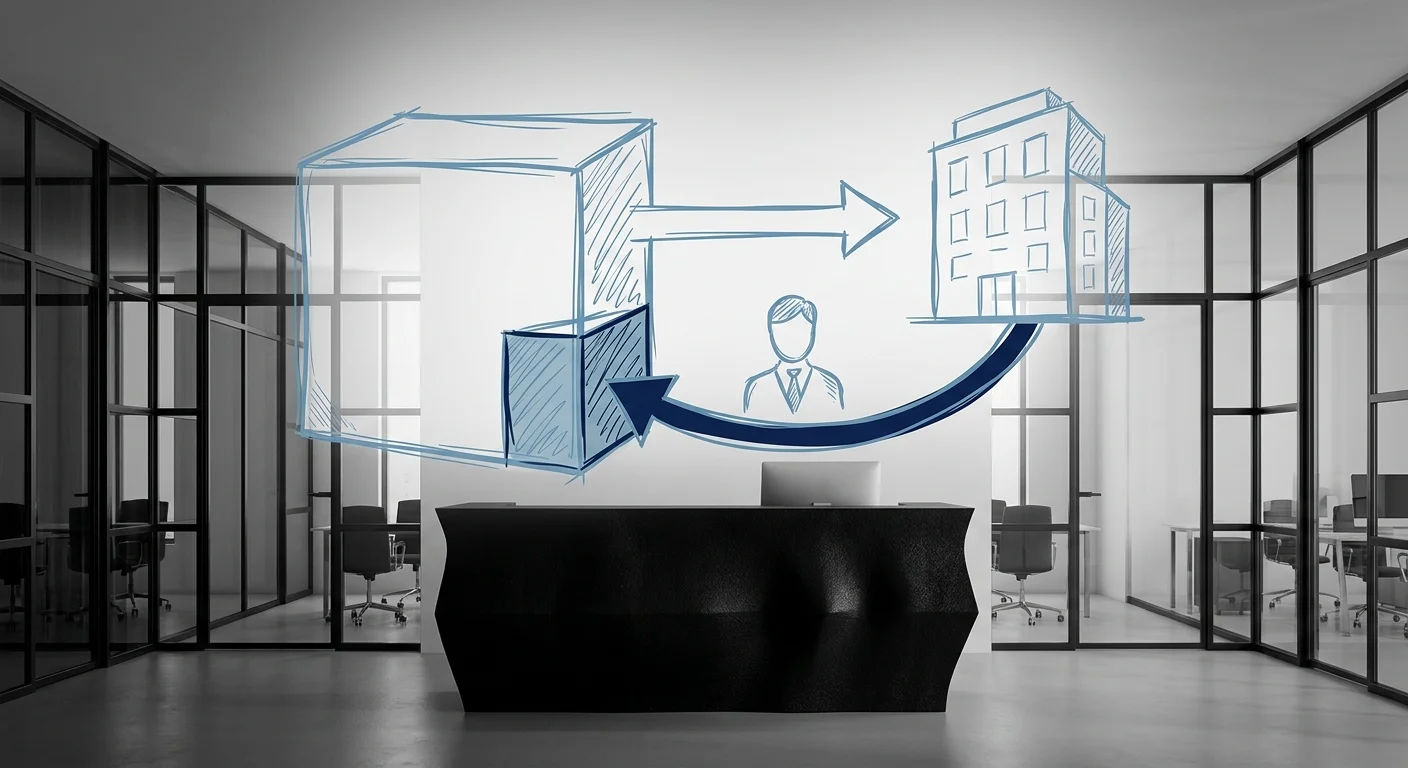
That's only half the tax picture.
Every dollar of mortgage interest on a commercial property loan is deductible as a business expense. That deduction runs alongside depreciation — two separate write-offs hitting taxable income at the same time, every year you hold the building.
A lease payment is deductible too. But it's also a cost that escalates on a schedule the landlord controls — not you.
Mortgage interest is tied to a loan balance that shrinks over time. Front-loaded in the early years. Predictable across the entire hold. That's the structural advantage a tenant never gets.
Here's the plain version: the IRS is subsidizing a portion of your debt-service cost.
That subsidy doesn't exist on the tenant side of the ledger. For any business comparing long-term ownership against long-term leasing, the interest deduction is one of the clearest separators in the math.
How Mortgage Interest Deductions Reduce Your Effective Borrowing Cost
Mortgage interest reduces your effective borrowing cost dollar-for-dollar against your marginal tax rate. If your business is in a 35 percent combined federal and state bracket, a portion of every interest payment comes back as a reduced tax bill.
You're not eliminating the cost. You're shrinking it — by a percentage the IRS sets and the landlord can't touch.
The deduction applies to the interest component of each payment — not the principal. In the early years of a commercial mortgage, interest is the dominant share of what you're paying.
That's when the write-off carries the most weight. The debt balance is largest. The interest portion is highest. The deduction reduces taxable income the most — at exactly the moment the business is carrying its heaviest financial load.
Stack annual depreciation on top of that interest deduction, add Section 179 expensing in any improvement year, and the combined write-off looks nothing like a lease payment running on a landlord's escalation schedule.
Businesses that own rather than lease long-term consistently point to this compounding interest-plus-depreciation layer as the mechanism that makes the spread real. Not abstract savings — a structural cost advantage that widens every year the mortgage runs while the tenant's rent keeps climbing.
SBA 504 Loan Requirements and the Owner-Occupancy Mandate
The SBA 504 loan program is the primary financing vehicle for owner-user commercial acquisitions. And it comes with one structural requirement that defines the entire transaction. Per SBA program guidelines, borrowers must occupy at least 51 percent of an existing building — or at least 60 percent of a newly constructed facility.
That threshold isn't a detail you negotiate around. It's the program's core eligibility test.
The SBA 504 was built for businesses buying space they intend to operate from. Not investors acquiring property to collect rent while they run the business somewhere else.
If a business plans to lease out the majority of the building, the 504 structure isn't available. The Orange County commercial real estate hub market reflects this distinction clearly — owner-user acquisitions and pure investment purchases run on entirely different financing tracks, evaluated by entirely different criteria.
When the occupancy requirement is met, the 504 structure delivers long-term fixed-rate financing with below-market interest rates. The monthly payment is predictable. The interest deduction is calculable from day one.
A fixed SBA mortgage payment is the clearest expression of who controls your occupancy cost. The landlord's ability to reprice at every renewal isn't negotiated down. It's permanently removed.
Who Should Not Be Looking at Owner-User Purchase
Not every business belongs in an owner-user acquisition. Knowing that early is actually the more useful place to start.
If you want the fastest possible close with no intention of occupying the space yourself, this path isn't a fit. The SBA 504 occupancy mandate exists because the program was built for operating businesses — not passive investors.
A business buying a building primarily to collect rent from tenants while operating elsewhere doesn't meet the threshold. And it wouldn't benefit from the owner-user tax stack regardless — because those deductions are built around the operational use of the property, not just the ownership of it.
The same logic applies to businesses sitting in soft submarkets. High landlord vacancy. Real tenant improvement dollars on the table. A well-negotiated lease can be the right short-term move — and pretending otherwise doesn't serve anyone.
The SBA 504 path makes the most sense when lease escalation risk is real, the occupancy commitment is long-term, and the business has the operating stability to service commercial debt. Those three conditions — not the tax advantages alone — are what make the purchase decision defensible.
| Financing Structure | Down Payment Requirement | Owner-Occupancy Threshold | Interest Deductibility | Ideal Buyer Profile |
|---|---|---|---|---|
| SBA 504 Loan | Typically split between a conventional first mortgage and a CDC second mortgage, resulting in a lower total down payment than conventional financing alone | At least 51 percent of an existing building; at least 60 percent of a newly constructed facility | Fully deductible as a business expense on the interest portion of each payment | Operating business purchasing space it will occupy and run its primary operations from |
| Conventional Commercial Mortgage | Lender-determined; generally higher than SBA-backed financing, reflecting greater lender exposure without a federal guarantee | No federal occupancy mandate; lender underwriting standards govern | Fully deductible as a business expense on the interest portion of each payment | Owner-users who do not meet SBA eligibility criteria or prefer conventional loan terms and structures |
| Commercial Long-Term Lease | No down payment; security deposit and first/last month obligations at signing | No occupancy threshold — tenant occupies space under landlord terms | Monthly rent payment is deductible as an operating expense, but the payment amount escalates at landlord-controlled intervals | Businesses with short-term space needs, high operational uncertainty, or submarkets with strong tenant concession environments |
| SBA 7(a) Loan | Lower than conventional financing; flexibility on use of proceeds is broader than the 504 program | Owner-occupancy is expected but less rigidly structured than the 504 program's specific percentage thresholds | Fully deductible as a business expense on the interest portion of each payment | Owner-users needing more flexible use-of-proceeds terms or acquiring smaller properties outside 504 project size parameters |
The 1031 Exchange: Deferring Capital Gains When You Eventually Sell
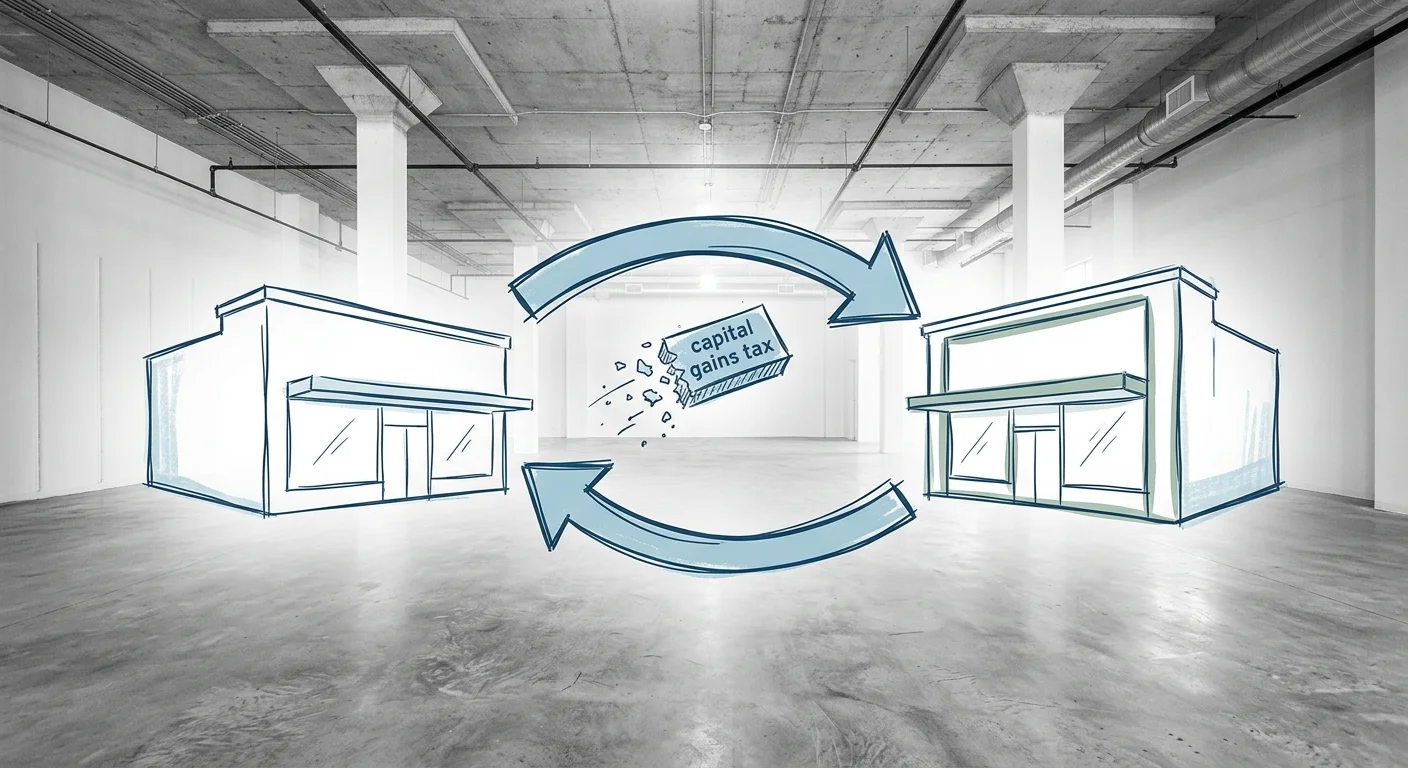
Depreciation, interest deductions, Section 179 — those run every year you hold the building. The exit is a different conversation. Section 1031 of the Internal Revenue Code lets you sell, defer the capital gains tax on everything you've built, and roll the full proceeds into the next qualifying property. No tax event. No interruption.
That's the separation. A business that leased its space for a decade walks away with nothing when the lease ends. The owner-user who sells has built equity, captured years of depreciation, and can now deploy the full sale proceeds into the next acquisition. The position compounds. The tenant starts over.
This is the exit math landlords count on their tenants never running. Every lease renewal resets the clock. Every 1031 exchange keeps the equity moving.
How Section 1031 Works for Owner-User Commercial Properties
A Section 1031 exchange lets a business sell a commercial property and defer capital gains — as long as the proceeds go into a like-kind replacement property. Per IRS exchange guidance, the Tax Cuts and Jobs Act of 2017 narrowed this treatment to real property not held primarily for sale. Owner-user commercial buildings sit squarely inside that definition.
The IRS treats the exchange as a continuation of the original investment — not a sale. The gain doesn't go away. It gets deferred into the cost basis of the replacement property, where it sits until that property is eventually sold outright. But here's the part worth understanding: an owner-user who executes successive exchanges can push that liability forward across an entire business lifetime. The tax event keeps moving. It never has to land.
For Southern California owner-users, this goes beyond the federal math. Corina Irvin structures ownership analysis around the full lifecycle — acquisition through exit — because the exit conversation belongs at the beginning, not the end. A property acquired without factoring in 1031 eligibility can inadvertently get disqualified from exchange treatment when the time comes. That's a structuring error that shows up years later, when the stakes are highest.
Timing, Identification Rules, and What Disqualifies a Property
The IRS doesn't give you much runway. Once the relinquished property closes, you have 45 days to formally identify replacement candidates. The full exchange must close within 180 days of the original sale. Both deadlines are hard stops. Miss either one and the exchange collapses — the deferred gain becomes fully taxable, immediately.
The standard three-property rule limits you to identifying three potential replacements. Broader identification is permitted under alternative counting rules, but each comes with additional constraints. The practical reality: you need to start the replacement property search before the sale closes. A 45-day identification window inside a compressed Southern California commercial market is not forgiving. The search doesn't start at closing — it starts months before.
Disqualification comes down to intent. Property held primarily for sale — inventory, development projects built to flip — doesn't qualify. Owner-user commercial real estate held for productive business use qualifies cleanly. The IRS draws a sharp line between a business buying space to operate from and a developer turning assets for profit. For the operating business, the 1031 structure was built exactly around that use case. It closes the ownership lifecycle with the same structural logic the mortgage interest deduction used to open it. Who controls your number — at acquisition and at exit.
| 1031 Exchange Requirement | Rule Detail | Common Disqualifier | Strategic Consideration |
|---|---|---|---|
| Like-Kind Property Requirement | Replacement property must be real property of the same nature or character as the relinquished property | Attempting to exchange into personal property, stocks, or non-qualifying assets after the Tax Cuts and Jobs Act of 2017 restricted the treatment to real property only | Owner-user commercial buildings qualify cleanly — the operating business's use case aligns directly with the IRS definition of qualifying real property held for productive use |
| 45-Day Identification Window | The exchanger must formally identify replacement property candidates within 45 days of the relinquished property closing | Waiting until after the sale closes to begin the replacement property search — a compressed Southern California market leaves no margin for a late start | Replacement candidates should be under active evaluation before the original property goes under contract, not after it closes |
| 180-Day Exchange Closing Deadline | The full exchange must close within 180 days of the original sale — missing this deadline triggers full gain recognition with no recourse | Delays in financing, title, or due diligence that push the replacement closing past the hard deadline | The exit timeline belongs in the acquisition analysis from day one — a purchase structured without the exit in mind can inadvertently compress the replacement window |
| Three-Property Identification Rule | Under the standard rule, the exchanger may identify up to three potential replacement properties regardless of their value | Over-identifying properties without a realistic path to closing on any of them, leaving the exchanger without a viable replacement when the deadline arrives | Alternative identification rules permit broader candidate pools but carry additional constraints — the right approach depends on the specifics of the replacement search |
| Intent at Time of Sale | The property must have been held for productive use in a trade or business — not primarily for sale or as inventory | A property that was converted to a short-term resale or development project before the sale can lose qualifying status regardless of how long it was originally held for business use | Owner-user buildings held for ongoing business operations qualify directly — the distinction between an operating business and a developer flipping assets is the core test |
| Gain Deferral vs. Elimination | The deferred gain is embedded in the cost basis of the replacement property — it is not erased, only deferred until the replacement property is eventually sold outside an exchange | Treating the deferred liability as permanently eliminated and failing to account for it in the replacement property's long-term financial analysis | Successive exchanges can defer the liability across an entire business ownership lifecycle — the compounding effect is the strategic advantage, not any single transaction |
Frequently Asked Questions
The tax mechanics are real. But the right answer for your business depends on how the code actually works — not how a broker summarizes it in a pitch deck.
These are the questions business owners ask when they're actually running the numbers. Direct answers only — grounded in the tax code, not approximations.
What are the primary tax advantages of owning my commercial building instead of leasing in 2026?
Four. And they stack.
Mortgage interest is fully deductible as a business expense — every dollar of interest paid comes directly off taxable income. The building depreciates over its statutory recovery period, producing a non-cash deduction every single year you hold it. Qualifying improvements — roofs, HVAC systems, fire protection, alarm systems — can be fully expensed under Section 179 in the year they're placed in service, not spread across decades. And when you sell, a Section 1031 exchange lets you defer the capital gains tax entirely by rolling the proceeds into a like-kind replacement property.
A tenant captures none of these. Every rent check is an operating expense and nothing else. No depreciation. No interest deduction. No exit-side option when the lease ends.
How does cost segregation actually work, and do I need an engineer to do it?
Cost segregation is an engineering analysis. A qualified specialist physically inspects the building, reviews construction records, and breaks the property into its component parts — structural elements, land improvements, personal property — assigning each to the shortest depreciation schedule the IRS permits.
Instead of one slow deduction running over 39 years, you get a layered structure where qualifying components depreciate in 5, 7, or 15 years. More of the deduction lands early — when the mortgage is newest and operating capital is tightest.
Yes, you need a certified cost segregation specialist. The IRS expects a detailed, asset-by-asset study — not a spreadsheet estimate. But the cost of that study is typically recovered fast through the accelerated deductions it generates, particularly in the first few years of ownership.
Can I use an SBA 504 loan to buy commercial property, and what are the occupancy requirements?
Yes. But the occupancy requirement is the piece most buyers miss until it's too late to restructure the deal.
The SBA 504 program requires borrowers to occupy at least 51 percent of an existing building — or at least 60 percent of a newly constructed facility. That threshold isn't negotiable. It's the eligibility test the program was built around, and it exists specifically for operating businesses buying space they intend to use.
If your business meets that threshold, the 504 structure delivers long-term fixed-rate financing. The monthly payment is predictable. The interest deduction is calculable from day one. Fall below the occupancy floor and the 504 isn't available — regardless of credit strength or deal size.
How do mortgage interest deductions reduce my effective borrowing cost as an owner-user?
The IRS treats mortgage interest on a commercial property loan as a deductible business expense. A portion of every interest payment comes back as a reduced tax bill — the exact amount set by your marginal tax rate.
You're not eliminating the cost of borrowing. You're shrinking it. And the deduction front-loads exactly when it matters most: early in the loan, when the amortization schedule is most heavily weighted toward interest, the write-off is at its largest. That's when the business is carrying the heaviest financial load.
A tenant writing a rent check gets no equivalent offset. The payment leaves. Nothing comes back. That gap compounds across the full hold period — it isn't just an annual math difference.
What are the tax implications if I lease out a portion of my owner-occupied commercial property?
Leasing out part of your owner-occupied building triggers rental income — and rental income is taxable. But it also opens deductions tied to that rental portion: depreciation allocated to the leased space, maintenance costs, and a proportional share of other property expenses all become deductible against it.
The owner-user tax advantages don't disappear. They get allocated between the occupied and leased portions. The Section 179 expensing rules and the SBA 504 occupancy requirements both stay relevant — your business still needs to meet the minimum occupancy threshold to keep 504 eligibility intact.
The tax picture gets more complex with partial rental use. That's an argument for having a CPA model the specific allocation before you sign any tenant leases — not after you've already committed.
How does a 1031 exchange work when I sell my owner-user commercial building?
A Section 1031 exchange lets you sell your owner-user commercial building and defer the capital gains tax entirely — provided you reinvest the proceeds into a like-kind replacement property. The Tax Cuts and Jobs Act of 2017 limited this treatment exclusively to real property not held primarily for sale. Owner-user commercial buildings qualify directly under that definition.
The timelines are strict. You have 45 days from the close of the relinquished property to formally identify replacement candidates. The exchange must close within 180 days of that original sale. Miss either deadline and the exchange collapses — full gain recognition hits in that tax year.
In a compressed Southern California commercial market, a 45-day window is not generous. Replacement property identification needs to start before you close on the sale — not after. A reactive search is how an exchange fails.
Where These Tax Benefits Actually Show Up — and What They Require
These aren't four separate tools. They're one system.
Depreciation reduces taxable income every year you hold the building — no transaction required. The interest deduction lowers your effective borrowing cost dollar-for-dollar, front-loaded in the years the debt is heaviest. Section 179 eliminates the depreciation waiting period entirely for qualifying improvements. The Section 1031 exchange keeps your equity in motion at exit instead of surrendering a share of it to capital gains.
Each layer reinforces the next. That's not a coincidence — that's how the code was built.
But none of that math means anything without a comparison.
A Southern California landlord writing escalation clauses controls your rent number at every renewal. You don't negotiate the schedule — you accept it or you leave. An owner-user locks in a fixed mortgage payment on day one. That number doesn't escalate. There's no landlord on the other side of the table, because there isn't one.
The tax shields accelerate that advantage. They don't create it. The ownership structure creates it. Peninsula Commercial Real Estate Group works with businesses that want both sides of that math — not just the acquisition case, but the full comparison — before committing to either path.
The tax benefits are real. The IRS code spells out exactly how each one works — none of it is speculative.
The harder question is whether your business is positioned to capture them. Whether acquisition makes more economic sense than a well-negotiated lease in your specific submarket right now. That answer requires current comparable data, an honest read on your occupancy commitment, and a full view of the ownership lifecycle from acquisition through exit.
So here's the only question that matters: who controls your number? The landlord writing your next escalation clause — or you running the comparison first.
The tax stack is real. The submarket comparison is the work most business owners never do before signing another renewal. So they hand that negotiating power back to the landlord — and wonder why their rent keeps climbing. If you're within range of a renewal or looking at acquisition, that comparison is worth running now. Request a strategic property consultation